


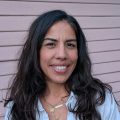
Adriana Martínez was 3 years old when she and her family moved from Pico-Union to Boyle Heights in 1974. They settled in Aliso Village, an underfunded and neglected low-income housing development notoriously known for its gang activity in the 1980s.
Her mom watched like a hawk as Martínez and her sister played ball games with the neighborhood kids and signaled truck drivers to honk their horns by pumping their fists up and down. When her dad was away doing field work, Martínez’s mom used a broom to fend off intruders trying to break in through their kitchen window.
Living so close to the 101 freeway off ramp, pedestrians were often hit by cars and instead of being helped, their valuables were stolen. These acts of desperation juxtaposed Saturday carpools with Black and Brown kids from the community to play instruments at a Cal State L.A. music conservatory.

“Life in our little two-bedroom apartment contrasted with the external environment, which was often threatening,” said Martínez, whose dad was held at knifepoint after cashing his paycheck at a corner store on First Street. “But there were also great experiences. It really shaped who I am, my work ethic, my values.”
Martinez recounts the struggles that fueled her successes in her first self-published memoir, “Reclaiming Me: Lessons from a First-Generation MexiCAN Daughter,” released in early September.
In the book, she describes how a love for learning instilled by her mother kept her college-bound. Although Martínez’s mother only made it to the 3rd grade in her rural Mexican town in Durango, Mexico, she valued education and never took for granted access to free public schools while raising her daughters in the U.S.
“My mom was our rock,” Martínez shared. “She always emphasized that my main job was to do well in school and make sure we went to college.”
Martínez was valedictorian of her graduating class at Roosevelt High School and attended Stanford University on a full-ride scholarship. Feeling out of place, but challenged, she joined the crew team despite not knowing how to swim. She was questioned by other Latinas for not living in the Mexican-American dorm.
In 1997, she bought her mother a home in West Covina after saving up money working for former Rep. Lucille Roybal-Allard in Washington D.C. She earned an MBA from the UCLA Anderson School of Management and was assistant deputy mayor of economic development for former Mayor Antonio Villaraigosa. In 2007, she started her own consulting firm providing economic opportunities for underserved communities, which allowed more time to focus on her children.
It was her children, she says, who inspired her to write her memoir – a labor of love she’s been wanting to do for 25 years.
“I want to leave something behind,” she said. “Fundamental advice. Words of wisdom.”

We spoke to Martinez about her writing journey and life growing up in Boyle Heights.
This interview has been edited for clarity and length.
When did your love of writing start?
In grammar school. I loved to read, which helped develop a skill for writing. We didn’t have a library nearby–Benjamin Franklin was too far and my mom didn’t drive–but there was a bookmobile that came [to the projects] every Monday. My mom took us religiously and the librarian saved the best and newest books for us. I entered young author contests and won. I still have books I wrote when I was little. One of them was called “Valerie & Kimberly” based on my best friend Bobby Joe, who also grew up in the projects and is Native American. It’s about our ups and downs as friends. I’ve always thought writing to be therapeutic.
What was your writing process like?
One thing I learned early on as a kid, is discipline. I really tapped into that. I’m not a procrastinator. I’ve always been one of those sit-down-and-do-it types. I just needed to prioritize it. I carved out time on Saturdays and Sundays early in the morning before my husband and kids got up. It was a two and a half year process. I tackled one chapter at a time. First, I grabbed the screenplay I wrote back in 2002 for a screenwriting workshop I took with Josefina López after grad school. I think I was the only student that actually finished their screenplay. It was sitting in a box on a little floppy disk, so I read it and started to go down memory lane. I wrote a short essay in 1999 for “El Andar” called “Coming of Age in the Projects,” which the first two chapters are based on.
In your memoir, you explore identity, mental health, personal loss and spirituality. How are these themes central to your story?
The chapter entitled “Graduation and Death,” is about my personal struggle. I had this beautiful life at Stanford, but I was really struggling emotionally because my dad wasn’t well. I didn’t know what to call it back then, but he was definitely going through mental health issues. He was depressed, spiraling emotionally and mentally, and not getting help. I resorted to drinking to cope with my sadness and anger following my father’s death. Drinking and driving almost cost me my life. Writing – and a strong faith I learned from my mom – helped me get through. I end the chapter with a poem I wrote after my dad passed that expresses my emotions and guilt and how I moved forward.
You have a chapter in your book titled “Turning Point” about your dad losing his job when you were 12. How did things change after that?
Our dreams of moving vanished. He had a stable job. Very low pay, but steady. He was an assembler in the Magic Chef factory. The company moved to Ohio and rather than uproot the family, my father chose to stay. He never found steady work again. What didn’t help was his diabetic condition. It was very debilitating and he wasn’t able to pass the physical exam. It was his greatest frustration. He ended up working whatever he could find–field work, he was a paletero, and did dishwashing for a while.

Your mom’s push for education is another chapter in your book. What influence did your mom have on your being so focused?
My mom was a homemaker. She worked very hard to get her GED and became a naturalized citizen. She volunteered at the school cafeteria. It was her way of keeping an eye on us. She eventually became a part-time cafeteria worker for LAUSD. She was very committed to sending my sister and I outside of the neighborhood for junior high. Our homeschool was Hollenbeck, which had a bad reputation at the time and we were doing very well at Utah Street Elementary. I was bussed out to Eagle Rock for the highly gifted magnet program. It was such a blessing and set me on a path to college. I came back to the magnet program at Roosevelt.
What’s been the most rewarding part about sharing your story?
It’s a gift to myself and to my children. There are a lot of universal themes–mental health, spirituality, culture. I [wrote it] for other first-generation youth, growing up in working class, low-income families. That’s my target audience. I’m very passionate about working with that population. That’s where I spend my volunteer and extracurricular time. I go back to Roosevelt for Career Day and speak to students. I’m on the advisory boards of the Hispanic Scholarship Fund and the Dream Academy in Salinas. They work with first-gen children of farmworkers. The whole farmworker community is very special to me because it’s a way to honor my dad.
What do you hope readers take away from your book?
I want other youth growing up the way I did to not only be inspired, but take away lessons and put them into practice. There’s a lot of practical advice on how to create wealth and [stay] spiritually connected. My goal is to have students growing up in Boyle Heights and other low-income communities read my book.
“Reclaiming Me: Lessons from a First-Generation MexiCAN Daughter” is available on Amazon and Barnes & Noble. On Saturday, Oct. 12, Martínez will be signing pre-purchased books in the main quad at Roosevelt High School from 10 a.m. to 1 p.m. The first 20 students will receive a free signed copy.
It’s great to read such positive stories. It’s such a familiar story and it’s nice to see it on paper.