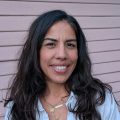
More than three decades after he published the highly acclaimed “Always Running: La Vida Loca, Gang Days in LA,” Luis J. Rodriguez is revisiting his memoir through a new exhibit at the Vincent Price Art Museum (VPAM) at East Los Angeles College.
The show features rare, mostly black-and-white photos Rodriguez took growing up in South San Gabriel and hanging out in Eastside neighborhoods in the 1960s to the 1980s, capturing early gang life, style, identity and everyday moments of young Chicanos and Chicanas.
The only color images highlight vibrant murals Rodriguez painted on local businesses, libraries and in the garage where he lived after taking part in the Chicano Moratorium. Bright red and orange Aztec and Chicano imagery reflect his shift toward art, activism and cultural awakening.

Curated by photographer Noé Montes and VPAM curatorial assistant Gloria Ortega, the exhibit features 23 photos Montes selected from boxes of keepsakes, negatives and prints Rodriguez kept in storage for over 50 years.
“I read “Always Running” when I was 12 and it was one of the first books that spoke to me,” said Montes. “There were so few books about our communities back then. I was like, ‘I know these people. I know what they’re living through.”
With support from the Eastside Arts Initiative, Montes selected, scanned and printed the photos. The exhibit premiered at Tía Chucha’s Centro Cultural, co-founded by Rodriguez, before traveling to Eastside spaces like CASA 0101, Inner City Struggle and Plaza de la Raza.
In an email, Rodriguez, a former poet laureate, reflected on his journey from gang member to award-winning author and social justice advocate.
The exhibit features photos of Chicano barrio life, gang meetings and one of teenage receptionists who worked at a local community center. Is this where you were introduced to photography?
South San Gabriel got its first community nonprofit, called the Bienvenidos Community Center in the 1970s. They created the John Fabela Youth Center, named after my homeboy who was killed. They got youth jobs and provided arts programming through civil rights legislation. I painted 10 murals through these programs and joined the photography program run by Ruben Juarez. He gave us cameras and we had darkroom equipment where I learned to develop film and prints. These programs helped curtail gang violence, but President Nixon cut these programs throughout the country and by the mid-1970s, they were gone. For a short time, I was fortunate to benefit from these programs, which helped me get out of gangs and drugs, and later, create my own arts-based cultural center and bookstore.

Some of your early works and influences appear in the exhibit. What inspired you to paint murals in the neighborhood? Are any of them still up?
Bienvenidos got federal funds for arts programming. My mentor, whom I called Chente in “Always Running,” convinced me to do this if I agreed to return to school. I had been doing gang graffiti on walls and drawings in notebooks. Because I had “palabra” (my word), I returned to the high school that kicked me out and graduated with my high school diploma in 1972. The murals were outside local businesses, inside the Del Mar Library and at the Bienvenidos Community Center. They all got whitewashed.
This exhibit has been shown in Eastside spaces like Boyle Heights and East LA. What does it mean to you to have these images seen by communities here today?
People are coming to the exhibits because we don’t have many old photos from those days to display … I hope we can gather all this material from all over East LA and somehow safeguard this somewhere. Our history, our culture, our expressions are in those photos.
You were part of the East LA walkouts and the Chicano Moratorium. What do you see in today’s generation of young people in East LA and Boyle Heights and other neighborhoods that reminds you of that time or feels different?
The recent protests and walkouts against ICE remind me of those heady days of the early Chicano Movement. That’s how it was in the late 1960s and early 1970s … In recent years, there’s been an upsurge in community-based spaces like Tia Chucha’s, Plaza de la Raza, Self-Help Graphics, CASA 0101, Espacio 1839, Inner City Struggle and more. This feels like those old days. The Chicano Movement is still alive and strong, even if taking other iterations. Things have to change, but the heart of our resistance continues to beat.
What did East LA College and the surrounding community mean to you at that time in your life?
I went to ELAC briefly in late 1979 and early 1980s. I took night classes like creative writing, journalism and speech. I never graduated or obtained a degree, but I consider ELAC my alma mater … I got some of my first creative writing pieces published at ELAC. The journalism professor helped me apply and get into the Summer Program for Minority Journalists at the University of California, Berkeley. They also got me my first daily newspaper job in San Bernardino. From there, I wrote for magazines and newspapers around the country as a freelancer and eventually ended up in Chicago working for newspapers and news radio as a reporter/writer for CNN, Westinghouse and NBC. ELAC was my springboard, the whole Eastside was my mother. I’ll be forever grateful.
What do you hope folks take away from the exhibit?
The photos at VPAM were the early expressions of a budding revolutionary thinker, writer and organizer. Bienvenidos impacted this scruffy cholo youth in ways that became life-saving.
How to visit:
“Always Running: Photography by Luis J. Rodriguez”
On view through June 13, 2026
Vincent Price Art Museum
1301 Avenida Cesar Chavez
Monterey Park, CA 91754
Special events:
A town hall is scheduled for Tuesday, May 5, from 12:15 p.m. to 1:30 p.m. at East Los Angeles College, and an exhibition walkthrough will take place on Saturday, June 13.