


By Josie Huang for LAist
Originally published on April 4, 2026
In Los Angeles, the soundtrack is familiar. Car horns, the whine of leaf blowers.
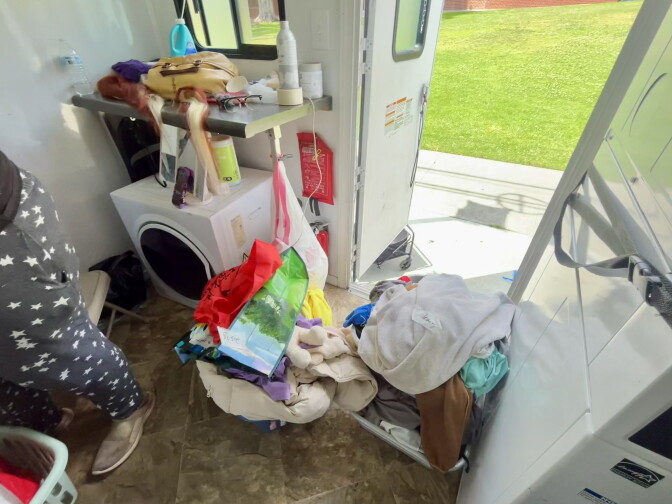
But in the middle of Chinatown, another sound cuts through the din: the rhythmic hum of washers and dryers from a trailer parked outside the Alpine Recreation Center.
Chinatown hasn’t had a laundromat for as long as anyone around can remember. This mobile setup – run by the nonprofit The Laundry Truck LA – has become the neighborhood’s de facto laundromat, offering the service for free to locals, twice a week.
For 70-year-old Sam Ma, it’s been a relief.
Ma, a retired construction worker, picked up freshly-laundered items — two pairs of pants, a hat, and some socks, bundled in a white garbage bag for the bus ride home.
He usually washes his clothes by hand. But about two weeks ago, he was hit by a car. Bruises and cuts cover his hands, making it difficult to scrub heavier items.
“The things I can wash, I wash,” he said in Mandarin. “But these are too thick. It’s too hard.”

Nearby, Laundry Truck employee Rebel Fox checked him out with a clipboard after handing him his load.
“We help a lot of seniors out here,” Fox said. “And we offer folding services, too. It really helps people who don’t have the dexterity in their hands.”
The Laundry Truck started out in 2019 providing laundry services to people experiencing homelessness across Los Angeles and has expanded to high-need communities, like Eaton Fire survivors.
In February, the nonprofit started operating in Chinatown under a year-long contract with Council District 1, showing up every Wednesday and Thursday at 9 a.m.
A sink or bathtub
Chinatown advocates say the lack of a laundromat is especially hard on low-income tenants living in older, neglected buildings.
“These landlords aren’t doing much to keep it updated,” said Sissy Trinh, executive director of the Southeast Asian Community Alliance.
Maintaining laundry rooms may require major plumbing upgrades and hookups that many landlords avoid.

Advocates say in buildings that do have shared coin-operated machines, they may be broken or in constant use. Many residents decide to launder clothes by hand — in sinks or bathtubs.
“In one building, the sinks were so small, people had to cut their sheets in half just to wash them,” Trinh said. “They’d wash one half, then the other.”
A reversal of access
Those who could benefit from a laundromat include seniors on fixed incomes, and workers living paycheck to paycheck, including garment workers and home health aides.
“You’re talking about low-income, financially-stressed households,” Paul Ong said.
Ong, who studies urban inequality at UCLA, says Chinatown reflects a broader pattern: as neighborhoods change, basic services can disappear.
The neighborhood’s last full-service grocery store closed in 2019 after the property was sold to a developer. Meanwhile, new market-rate housing has gone up, catering to higher-income residents with amenities like parking and in-unit laundry.
“The irony is that historically, laundry was bread and butter for the Chinese community,” Ong said.
In the late 19th and early 20th centuries, Chinese immigrants built livelihoods around laundry work — one of the few industries open to them at the time.
Nowadays, laundry options have become hard to come by.
Seeking a lasting fix
Residents without access to machines have to leave the neighborhood entirely to find a laundromat in Lincoln Heights or Echo Park, which has seen its own laundromats disappear.

“The long-term, permanent solution is that a laundry service opens up,” in the neighborhood, said Council member Eunisses Hernandez, who represents Chinatown.
Hernandez says constituents have asked for a laundromat from the time she was knocking on doors as a City Council candidate.
Hernandez, who is up for re-election this year, says the neighborhood could benefit from a community-run laundromat offering affordable services.
“If private industry is not making that investment in Chinatown then perhaps it’s up to the city – and the people of that neighborhood – to build something for them,” she said.
In the meantime, Hernandez has directed about $250,000 from her district — using TFAR payments from developers building larger projects — to cover a year of mobile laundry services.
The contract with the Laundry Truck runs through next February.
After that?
“We’ll keep filling the gap until we get to a permanent solution,” Hernandez said.
Could that solution be combined with housing?
Some community advisors to a new affordable housing project being developed on the northwestern edge of Chinatown have been pushing for a self-service laundry that would be open to other neighborhood residents, says Eugene Moy who sits on the advisory board of New High Village.
But any fix will take time. That project, Moy said, could be two years out from even breaking ground.
Taking a load off
Back at the truck, the machines continue to spin. By mid-afternoon, nearly 18 loads of laundry are done.

Two months in, there are kinks to work out. How to get more residents to take advantage of the unit’s capacity? Its machines can churn out 40 loads per shift.
There is also the question of whether some seniors are physically able to transport their laundry even a few blocks.
But the service is starting to get regulars. One woman on her second visit stood by the trailer, cradling just-washed clothes in her arms while clutching her daughter’s teddy bear, now a sparkling white.
“If it keeps going, I’ll keep coming,” said the woman who gave her last name as Mo. “It’s very convenient.”
Her apartment building doesn’t have a laundry room. Sometimes she asks a friend next door if she can use theirs. With three children, the cost adds up quickly.
Thinking aloud, she calculated how much she saved that day.
About $8, she estimated — money she said could now spend on her kids.
