


By Brianna Lee for LAist
Originally published on June 2, 2026
Election Day is here, but now comes the waiting.
Do you have something to watch on Netflix? Maybe you’ve been meaning to pick up a hobby — how about crochet? Whatever you do, take a deep breath and keep busy because it could be days (or weeks) before we get some California election results.
The state is often knocked by the rest of the country as being “slow” to count votes. But here’s the deal: that’s a feature, not a bug, of the election system.
The backstory
Things take a while here largely because California works so hard to expand the ways people can vote. For example:
- Californians in recent years overwhelmingly vote by mail — nearly 90% of votes cast in the 2024 presidential election were mail-in ballots. In that same year’s primary the percentage was just as high. Those ballots can be postmarked up to and including Election Day. They’re counted as long as the ballot arrives within seven days (for the June primary, that’s June 9).
- California offers same-day voter registration at any voting center. These new voters must cast a provisional ballot, which is counted once election officials confirm their eligibility (they are overwhelmingly accepted — for example, Los Angeles County reports that historically between 85% to 90% have been counted.
- Voters also have the right to cast provisional ballots if there’s any problem on election day — like if poll workers aren’t able to void an outstanding mail-in ballot, or if there’s any issue calling up voter information from e-pollbooks. Again (see above), provisionals take longer to process because eligibility has to be confirmed.
- Vote-by-mail ballots require signature matching. When the one received doesn’t match the one on file, county registrars must contact that voter to let them know — and give them the chance to correct it.
- And, with more than 23 million registered voters, we’re really, really big. In the 2024 general election more than 16 million Californians voted (down from nearly 18 million in the 2020 presidential election). Either way, that’s more people than the total populations of all but three other states.
Follow the vote after polls close
Our limited-run newsletter Make It Make Sense unpacks the ballot count and results, then checks in regularly on officials voted into office and the measures voters pass.Subscribe
Why things have sped up, some
But things have sped up considerably in the 30 counties that have adopted a 2016 law called the Voter’s Choice Act, including L.A., Orange and Riverside counties. In recent elections, the changes associated with that law — like voters not being locked into a designated polling location — drastically cut down the number of provisional ballots cast, which helped move things along faster than they had before.
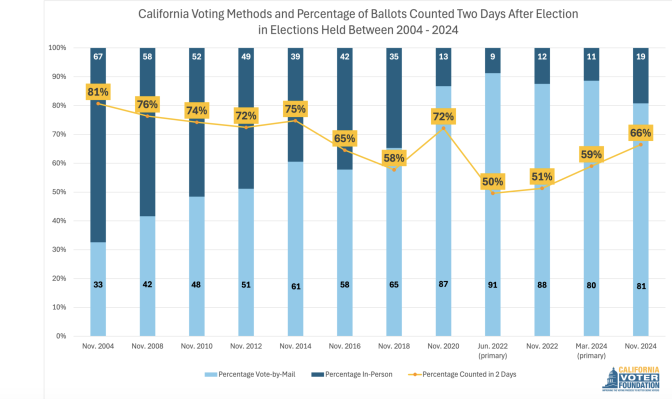
Still, accuracy and a commitment to “expanding the franchise” — translation: allowing more people to vote — means the process is not designed to produce instantaneous results.
Official results
The California Secretary of State’s Office is required to certify the final vote tallies by July 10, marking the official end of the 2026 primary election.
LAist’s Voter Game Plan will be back in the fall to help you prepare for the Nov. 3 general election.
Why you should take a deep breath Election Night
You’ll have to get that endorphin hit elsewhere on June 2.
A few things to keep in mind: You may recall that during the 2024 primary, it took about a week to call the results for L.A. City Council races in District 4, where incumbent Nithya Raman was fighting to avoid a runoff election, and District 14, where challenger Ysabel Jurado wound up overtaking incumbent Kevin de León by just a few hundred votes.
It took an even longer 15 days to call the results of Prop. 1, during which opponents conceded, walked back that concession, and conceded again when the measure won by a razor-thin 0.4% margin. And it took 23 days to call the second-place winner for Orange County’s 45th congressional district — it ultimately went to Democrat Derek Tran who went on to beat Republican Michelle Steel in the general election. Tran is now up for reelection and rematch with Steel is considered likely in November.
Depending on how close some of these races end up being, we may face similar waits this election cycle.
TL;DR: Officially, county and state election officials have until July 10 to certify election results — including a mandatory audit that requires hand-counting all of the ballots at 1% of precincts. Nevertheless, you’re going to see a lot of national media headlines about California’s relative “slowness.” Brush it off. We have sunshine, beaches, and a highly enfranchised population.
Editor’s note: This story was originally reported and written in 2020 and has been updated several times, including for the June 2026 primary, with current information. Libby Denkmann contributed to the original report and Megan Garvey did the most recent updating.
