


By Mariana Dale for LAist
Originally published on August 12, 2026
On Wednesday morning, Los Angeles Unified School District students returned to campuses for the first day of school. For many, that meant coming back to schools located near a Boyle Heights warehouse that burned for more than a week in June.
The disaster forced the district to relocate summer programs at several nearby schools, including Christopher Dena Elementary. But on the morning of back-to-school, Maria Bravo said she was ready for her third-grade son and sixth-grade daughter to get back into Dena Elementary classrooms
“ I know that they’re going to be in a good place here,” Bravo said. She said her kids needed a new routine after a summer spent largely indoors, trying to avoid the heat and the smell of rotting food wafting from the Lineage warehouse.
“They’re going to find ways to keep them busy and active, and at the same time safe,” Bravo said.
Principal Robert Salazar said classrooms have air purifiers and there’s a plan to bring students inside if rotting food smells interrupt recess or lunch.
“ It’s like three plans — we have, A, B and C,” he said.

However, as has been true throughout the summer, the odor varied across the neighborhood.
At Eastman Elementary, Ivett Dominguez walked her child to Eastman Avenue Elementary School and told LAist the smell outside was “consistent and annoying,” but that she didn’t notice it inside her son’s classroom.
Other parents were more critical of the district’s decision to reopen the schools while the clean-up continued.

Andrés Chait, LAUSD’s superintendent, said preliminary attendance results showed about 92% of students enrolled at campuses near the burned warehouse came to the first day of school, exceeding the district’s overall attendance rate of 90%.
“[I have] gratitude to our communities for having faith in us and in the measures that we took,” Chait said.
He said the district will take “corrective action” where lead and other toxins are found and that he’s directed his team to look into other ways for the district to advocate for climate justice.
“ Our primary role always is to provide education and academic advancement, but I think we can do more than that,” Chait said.
Some environmental health experts and advocates who reviewed the district’s testing results told LAist that school officials have more work to do on testing and cleaning at some campuses.
Environmental testing raises questions about long-term fire impact
District officials said environmental tests — which they released the day before school started — concluded the Boyle Heights warehouse fire did not result in widespread contamination at nearby campuses and affirmed the decision to reopen schools.
Soil tests found lead levels that exceeded California’s acceptable threshold at two elementary school campuses — Christopher Dena and City Terrace. The district said in its report that staff will evaluate whether more testing or cleanup at those sites is needed.
Carlos Torres, director of LAUSD’s Office of Environmental Health and Safety, said the front lawn at City Terrace and the tree wells at Dena, where elevated levels of lead were detected, have been fenced off.
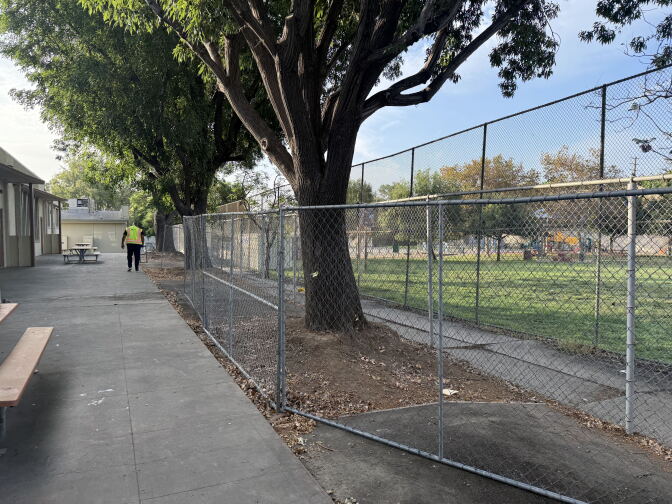
Torres said the district doesn’t believe the lead is tied to the warehouse fire.
“Most likely this could be from things like lead-based paints from use in the past. It could be from agricultural use,” Torres told LAist on Tuesday. “There isn’t such a thing as clean soil anywhere.”
The district said the levels of several other substances, including ammonia, formaldehyde and manganese, were low enough that they did not threaten the health of students or school staff.
Jill Johnston, an associate professor of environmental and occupational health at UC Irvine, agreed that elevated lead levels in the soil at nearby schools could have been present before the warehouse fire.
But she expressed concern about test results for ammonia at three schools within two miles of the Lineage warehouse: Eastman Avenue Early Education Center, Humphreys Avenue Elementary School and Stevenson College and Career Prep.
Two indoor samples and one outdoor sample from those campuses were found to have between 319 and 327 micrograms of ammonia per cubic meter.
“Ammonia is a respiratory irritant,” Johnston said. “It can affect lung function, particularly in kids… Breathing in ammonia, particularly at levels that are much higher than background concentrations, is something we want to try to avoid, especially for vulnerable kids.”
California’s Office of Environmental Health Hazard Assessment sets a 200 microgram safety limit for chronic exposure to ammonia, meaning situations where people are breathing in the chemical compound continuously. District officials noted that the test results were far below the state’s 3,200 microgram limit for acute exposure, meaning about an hour or less.
Johnston said closing schools would have been a difficult decision for district officials. But she said additional scrutiny and monitoring at those three schools is warranted.
“If they’re also kids from the neighborhood, they’re being exposed at home,” she said. “It just builds this evidence that we’ve been observing over the last several weeks, that toxic chemicals associated with the activities at Lineage are getting into the community, and in this case, is getting inside the schools.”
East L.A. has a long history of pollution linked to nearby freeways and dense industrial development. In May, about 25,000 gallons of crude oil spilled into the streets after an underground pipe ruptured.
“This continues to remind us where our schools are located and how vulnerable our communities and schools are,” said Rocío Rivas, school Board vice president and representative for the neighborhood. “I think it’s important to elevate the testing and continue to monitor regardless if there’s a fire or not.”
The teachers union sent a letter to the superintendent on Aug. 6 with more than a dozen demands related to Boyle Heights schools, including additional environmental testing, heating, ventilation and cooling system upgrades.
“Fire-impacted school communities deserve more than assurances — they deserve an actionable plan that puts health and safety first,” wrote Gloria Martinez, president of United Teachers Los Angeles.
LAist reporter David Wagner contributed to this story.
