


Voting is a right that can be taken for granted. But for many who will be voting for the first time, the Nov. 5 election represents a privilege and opportunity to be a voice for their community.
An estimated eight million youth and nearly four million newly naturalized citizens will be eligible to vote for the first time since the 2020 election, according to national figures.
Californians in 2020 voted to allow some residents with a criminal history the chance to vote, but these formerly incarcerated individuals don’t have the same rights in all U.S. states.
This wave of new voters could greatly influence the outcome of the upcoming election – as issues on the ballot, such as affordable housing, the economy, crime and safety, and healthcare, greatly impact their lives.
We spoke to an 18-year-old, a recently naturalized immigrant and a formerly incarcerated person – three voters from underrepresented communities – about what it means to cast ballots for the first time in the upcoming election.
Eztli De Jesus, 18-year-old student

Eighteen-year-old Eztli De Jesus will be voting for the first time next month.
“I think voting is a privilege,” said De Jesus. “If you’re able to vote, you should definitely go vote because it affects your life and community.”
The daughter of undocumented immigrants from Mexico, De Jesus is the first in her family to vote. Raised in Boyle Heights, she grew up going to community events, protests and rallies and as a child was introduced to spaces like Self Help Graphics & Art and Las Fotos Project, which nurtured her passion for social justice and community engagement.
Despite not being able to vote, her parents always stressed the importance of voting and researching candidates to help their daughter make informed decisions.
“Growing up with undocumented parents and watching them want to put their voices out there but not being able to is huge. It means a lot to make my voice heard.
Eztli De Jesus
De Jesus is one of an estimated 41 million Gen Zers eligible to vote in this year’s election. While studies show low voter turnout among youth in past elections, De Jesus is optimistic.
“I’ve seen a shift in young voters,” she said. “We want some new faces and relevant opinions in office. A lot of my friends are going to vote and that makes me hopeful for our future. Voting this year is going to be very revolutionary.”
She admits some young voters are apathetic and thinks out-of-touch politicians are to blame.
“Our government is made up of all these old white men. Our voices are dismissed. They don’t think we understand politics. They’re stuck on the same old ideologies. Politicians make it all about themselves, but in reality, this is our future we’re talking about.”
Eztli De Jesus
De Jesus was in the fifth grade when Donald Trump was first elected president in 2016. Despite only being 10 years old, she was impacted by his presidency and fearful for her community and family. She gets frustrated when young people take voting for granted.
“It’s hard to understand when you haven’t experienced the same fear that I have as a first- generation person,” she said. “It plays a big part in motivating me to use my voice and encourage my friends, people I work with, to do the same.”

A first-year student at Santa Monica College, De Jesus sees affordable housing, homelessness, access to art education in public schools and immigration as some of her top issues this election. De Jesus, who lives in a two-bedroom home in Boyle Heights with her parents and 13-year-old brother, says she doesn’t see herself moving out any time soon, citing the high cost of living in L.A.
The thought of making history by electing the country’s first woman of color president is another driver motivating her to vote.
“The perfect candidate doesn’t exist,” she said. “But in this situation, it’s the lesser of the evils. To have a woman in office as president would be life-changing.”
Candelaria Medina, 58, recently naturalized

Sept. 24, 2024 marked a big day for Candelaria Medina. It was on that day in a downtown L.A. immigration office that the 58-year-old Guanajuato, Mexico, native surrendered her green card and became a naturalized U.S. citizen. Surrounded by her family, Medina sang the national anthem and recited the pledge of allegiance. But the path to becoming a U.S. citizen wasn’t easy.
“It was a difficult journey. Immigration caught me crossing several times. I was 17 years old the [first] time and whenever they returned me back to Mexico, they would grab me and tear me away.”
Candelaria Medina
Medina is part of a wave of new U.S. citizens being sworn in across the country, as immigration authorities approve citizenship applications at the fastest speed in a decade. The Biden administration says the uptick is due to efforts to reduce a backlog of applications that mounted during the pandemic. Immigration officials say the timing isn’t election-driven or based on any political agenda. Either way, newly naturalized citizens like Medina look forward to voting.
“I’m excited,” said Medina. “I want to be part of the process to elect my representatives. I think it’s necessary for me as an American citizen.”
Medina lives in a three-bedroom home in South L.A. with her husband and three of their four adult children. She and her family see voting as a crucial way to raise their voices. It was her family – all eligible voters – who encouraged her to become a citizen and vote.
“I was afraid that maybe I wouldn’t pass the exam,” she said. “But it’s the easiest thing. It’s more what one puts in their mind. I think people who can vote should go out and raise their voice because we can’t remain silent. The more votes from our communities, the more resources we get.”
After 20 years running a sewing business, Medina now works as a supervision aide at Twentieth Street Elementary in South L.A. Immigration policy and LGBTQ+ issues are among her priorities this election, as her youngest son identifies as gay and experienced bullying and a lack of support at school.
Having had her run-ins with immigration, Medina harbors no resentment. Instead, she encourages those who are eligible to start the citizenship process. According to a recent Pew Research Center analysis of the U.S. Census Bureau data, naturalized voters account for about 10% of the U.S. electorate. That’s nearly 24 million immigrant adults eligible to vote in the upcoming presidential election.
Medina, who stays informed on election news by watching Univision and reading bilingual publications like this one, was reluctant to share her pick for president.
“I think it’s a secret vote,” she said. “But Kamala. 100%.”
Samuel Banda, 45, formerly incarcerated

Samuel Banda was only 17 when he made the biggest mistake of his life. Born in Placentia, he was raised by older siblings who regularly bullied and beat him while his parents were out working the fields. He found a refuge in gangs and in 1996, killed a rival gang member. After two years in the juvenile justice system, he was tried as an adult and convicted of first-degree murder. At 19, Banda was sentenced to 35 years in prison.
“Back then, because of my immaturity and distorted way of thinking I couldn’t comprehend the consequences. I didn’t know what was going to happen. I didn’t think far.” Band said.
In prison, Banda discovered his love for reading and learned about professors, lawyers and politicians dedicated to restorative justice and second chances. As he got closer to his parole board hearing, organizations like Initiative Justice and Anti-Recidivism Coalition (ARC) visited his Riverside County facility, giving him hope.
“I remember thinking maybe one day, if they ever give me a chance, I’m gonna vote. I started telling myself, ‘I’m gonna vote. I am gonna vote.’”
Samuel Banda
After 25 years of incarceration, he became eligible for a parole board hearing under Senate Bill 260, which acknowledges that the human brain doesn’t fully develop until the age of 25. In June 2023, Banda was released from prison and immediately sought Homeboy Industries, the largest gang rehabilitation and reentry program in the world.
“That lifestyle got old,” said Banda, 45, who lives downtown in interim housing. “I grew out of it. I matured. It was a senseless cause.”
Banda now has the chance to vote after California voters approved Proposition 17 passed in 2020, allowing individuals on parole for felony convictions the right to vote and restoring voting rights for approximately 50,000 people in the state.
So when the L.A. County’s Registrar-Recorder/County Clerk’s office set up voting registration booths at Homeboy Industries, Banda took full advantage.
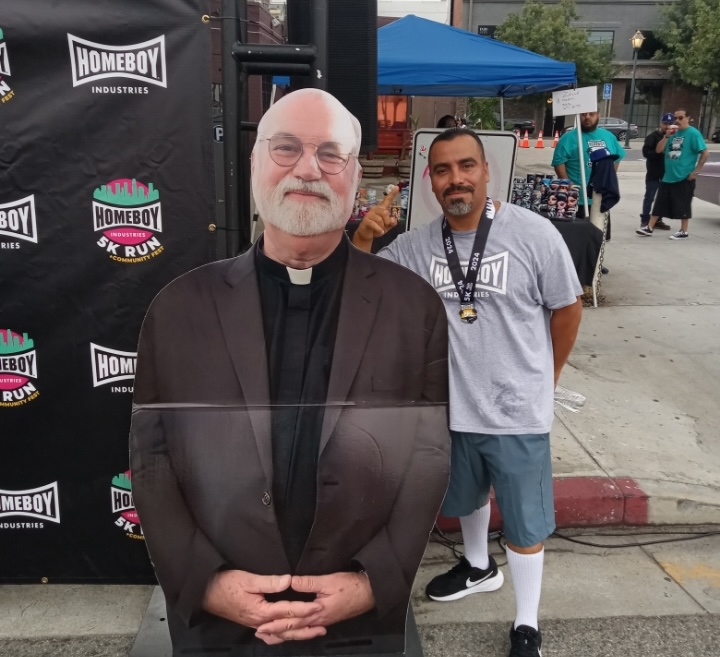
“I’m overjoyed. I feel like I’m being of service to my community, to my state,” said Banda about voting for the first time. “I don’t feel I have a right to it. I feel privileged that I’m being allowed to vote. I still have guilt and shame that l work on every day. However, the opportunity was given to be allowed to vote and I took it.”
As for presidential candidates, he doesn’t like Donald Trump’s stance on immigration and thinks Kamala Harris, a former prosecutor, contradicts herself. He and a circle of 25 former “lifers” who also got out of prison keep in touch and often talk politics. They remember Republicans and Democrats having similar stances on the justice system.
“Do we really owe a loyalty to a party when once upon a time they were both hard on crime?” he asked.
Banda’s loyalty is to people like Father Greg Boyle, or Father G, as he calls him, who founded Homeboy Industries in 1988, and all of those who believe in second chances.
“They saved us from rotting away in prison,” he said. “That place catches up with you and brings you down.”

Being a first-time voter in this upcoming election is nerve-racking enough. Having to help your family members through the process is even harder
Excellent article, very well articulated. It opens an often unseen window into the issues, concerns and residents that make up the community. Each one of them inspiring. Kudos!