


By Adolfo Guzman-Lopez for LAist
Originally published on August 12, 2026
Many immigrants come to Southern California to start businesses. But with federal raids targeting them and the cost of starting an enterprise rising due to inflation, learning how to become an entrepreneur has become increasingly challenging.
Some small business owners are getting help navigating this tough economy from the government of the country where they were born. Mexico’s consulate in Los Angeles held a graduation ceremony on Tuesday for its yearly Consular Entrepreneurship Program for Mexican Women Abroad.
It took place in a lecture hall at the consulate’s MacArthur Park offices without the musical fanfare of academic ceremonies but very much with the same feeling that the graduates accepting their certificates of accomplishment marked a learning milestone that will open better economic opportunities for this target demographic.
Consul General Carlos González Gutiérrez said the program’s goal is to help “the mothers, the women who are at the center of our community and who want to develop their own businesses … in order to raise a family.”

This is the program’s seventh year. A total of 112 women have now participated in the program. Organizers and graduates told LAist that this year’s training felt more significant due to the tension in Latino immigrant communities in the wake of federal raids that ramped up last year, along with sharp cost-of-living increases.
Help with business plans, finances and permits
The program enlists professionals working in credit unions, small business development groups and businesses large and small to train budding entrepreneurs.
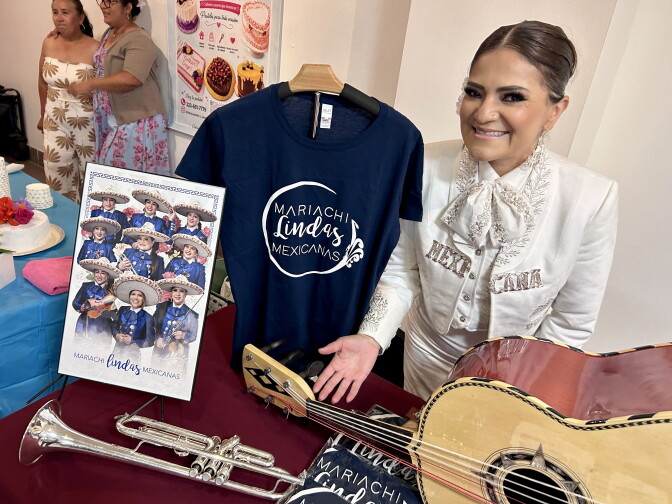
“It is important for me to learn about taxes, how to register the brand, how to promote and do branding,” said Maricela Martinez, who signed up for help with her musical group, Mariachi Lindas Mexicanas.
She’s run the band for 20 years, but nearly stopped after the pandemic and federal immigration enforcement led many Latinos, she said, to forgo mariachi entertainment.
Martinez was one of about nine graduates who showed off their businesses in a post-graduation reception. The tables were filled with products ranging from rosemary-infused essential oils and organic soaps to desserts and notary services.
“I signed up for this program because I had the dream of having my own business.”
— Saray Pallares, entrepreneur starting a notary business
“I signed up for this program because I had the dream of having my own business,” said Saray Pallares, who stood behind marketing material she created for her budding notary business. “I am a single mother of four.”

The items on Pallares’ table included a black polo shirt embroidered with her business’s branding. Her company’s name, La Firma Latina, can be translated as The Latina Firm, or The Latina Signature.
Pallares said she learned the most from training given by a marketing professional with a Guadalajara-based restaurant chain that has opened in Montebello. Sharing a culture and language with the trainer and the other budding entrepreneurs gave her the kind of support she felt was missing from business classes she took at community college, Pallares said.
Help mustering up courage as a woman and an immigrant
Extensive arrests of immigrants in Southern California by federal agents last year sowed fear in immigrant communities. But some of the participants in this program said that’s not holding them back.
“That’s more of a motivation to keep going, to keep fighting, to keep pushing back,” Pallares said. “I was thinking of having my business name in English, and I said, ‘No, I want to help my community. I want them to be able to say I trust her because she speaks Spanish.’”
That environment has been another roadblock for these participants, who also need to balance their work at home with their entrepreneurial dreams.
“[For] some of them, it’s the language. Some of them, it’s technology. Fear is always there, not knowing what to expect.”
— Claudia Shah, consultant at the L.A. County-based Small Business Development Center
Claudia Shah, a consultant at the L.A. County-based Small Business Development Center and a program trainer, said that this program has its own challenges. Twenty-nine women started the course, but only 15 reached graduation, she said, because of family and work responsibilities as well as the fears women have that keep them from finishing the course.
“[For] some of them, it’s the language. Some of them, it’s technology,” Shah said. “Fear is always there, not knowing what to expect.”

Shah said some even asked whether registering their businesses could lead to negative consequences for their immigration status.
But for those who completed the course, she said, the positive economic ripple effects will be felt in their households, their neighborhoods and the region.
